To teach reformer Pilates in Australia you need an industry-recognised reformer certification of at least 150 hours (or a nationally accredited Certificate IV or Diploma in Pilates), a current First Aid and CPR certificate (HLTAID011), and professional indemnity and public liability insurance. Pilates teaching is not government-licensed here. No single qualification is legally mandated. In practice, studios and insurers set the bar, and comprehensive training is what gets you hired.
That gap between “legally required” and “actually required” is where most aspiring instructors get caught out.
How to Become a Reformer Pilates Instructor in Australia: 5-Step Roadmap
Becoming an instructor means completing a recognised course, logging your observation and teaching hours, arranging insurance, and passing a practical assessment. Most people launch a teaching career in three to six months on the faster pathways, or twelve to eighteen months if they go comprehensive.
The 5-step certification checklist
Step 1: Secure your HLTAID011 (Provide First Aid) certification.
Almost every training provider, studio and insurer requires this, plus current CPR. First Aid is typically valid for three years and CPR needs annual renewal. Get it done early so it never holds up your enrolment or your first hire.
Step 2: Select an industry-recognised reformer course of at least 150 hours.
Look for courses recognised by Pilates Education, or nationally accredited qualifications listed on training.gov.au. Insurers and reputable studios both use these as their screening filter.
Step 3: Complete your anatomy and physiology theory modules.
This is the part people underestimate. Functional anatomy, biomechanics, contraindications and pathology all sit underneath safe cueing. If you cannot explain why a movement is unsuitable for a client with a disc injury, you are not ready to teach it.
Step 4: Log your observation, self-mastery and student-teaching hours.
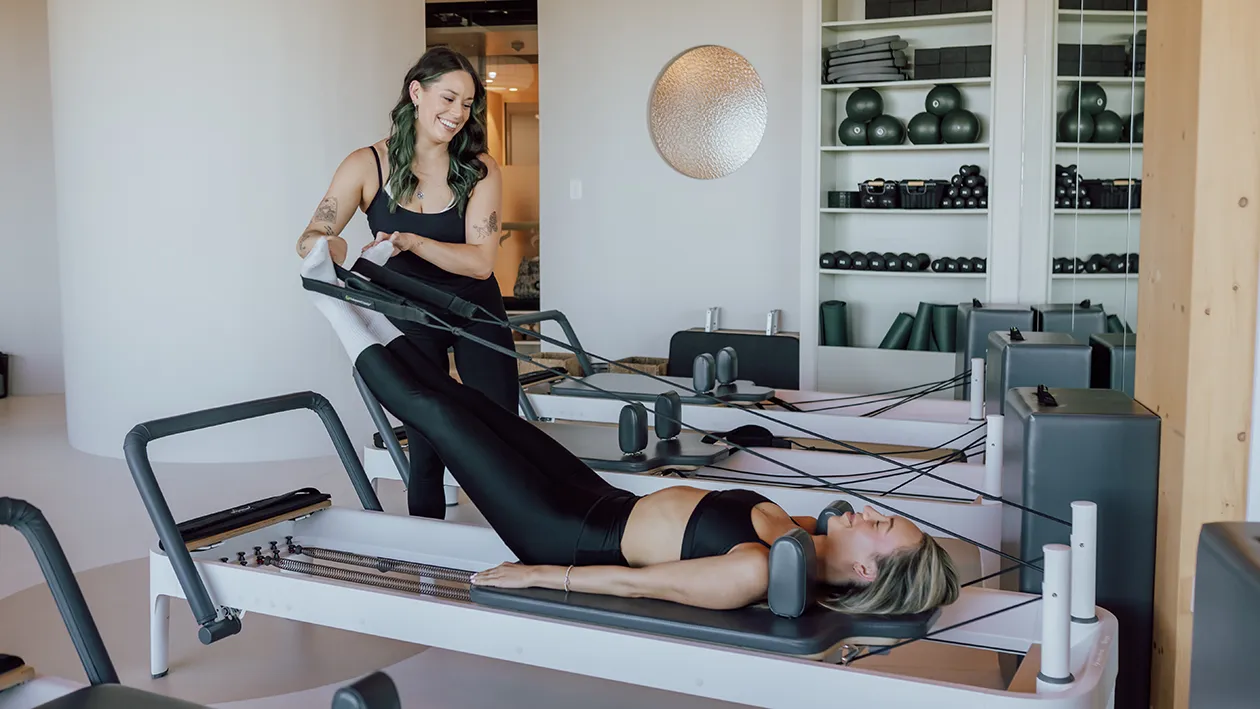
Comprehensive programs typically require a mix of watching qualified instructors, practising the repertoire on your own body, and teaching supervised sessions. This is where the qualification becomes real skill. Our own reformer teacher training builds supervised teaching in from the start for exactly this reason.
Step 5: Purchase professional indemnity and public liability insurance.
Cover usually starts at $1 million or more and is a precondition of teaching anywhere reputable. Your qualification determines what you are insured to teach, which is exactly why a matwork-only certificate will not cover you on a reformer.
Try this now
- Check your local First Aid provider for weekend HLTAID011 courses and book the next available date.
- Download the syllabus for two different reformer programs and compare them side by side on total hours, supervised teaching hours, and whether the qualification is accredited or industry-recognised.
Common mistakes to avoid
Choosing a weekend-only, unaccredited course. These exist, they are cheap, and many established studios will not accept them. If a course promises you can teach reformer after two days, ask which studios have hired its graduates.
Underestimating the anatomy workload. Students routinely enrol expecting a movement course and find themselves deep in an academic one. Budget real study time for it.
Assuming matwork certification covers reformer. It does not. Reformer is a separate scope of practice with its own training and insurance requirements.
Progress indicators
- Weeks 1 to 4: Anatomy theory and foundational repertoire. You should be able to name the muscle groups you are cueing.
- Weeks 5 to 12: In-studio observation and supervised teaching. You should be adjusting your cueing based on what you see in front of you rather than reciting a script.
What Qualifications Do You Need, and Which Course Is Best?
For maximum employability in Australia, choose a comprehensive program recognised by Pilates Education, or a nationally accredited Certificate IV or Diploma delivered by a registered training organisation. The more equipment your qualification covers, and the more supervised teaching hours it includes, the more doors it opens.
Comparison: course types at a glance
| Course type | Time commitment | Employability | Best suited to |
|---|---|---|---|
| Short-course reformer certification (non-accredited) | 2 to 4 days | Limited. Accepted by some boutique group studios, rejected by many | Existing fitness professionals adding a modality |
| Industry-recognised reformer certification (150+ hours) | 3 to 6 months | Strong for group reformer roles across most studios | People who want to teach group reformer sessions and start earning sooner |
| Nationally accredited Certificate IV in Pilates | Approx. 6 to 12 months | Strong across studios, fitness centres and independent practice | People who want a formal AQF qualification and a pathway to further study |
| Diploma or comprehensive certification (all equipment) | 12 to 18 months, 600+ hours | Highest. Clinical settings, rehab, allied health referral work, teacher training roles | Career instructors and anyone wanting to work alongside physiotherapists and exercise physiologists |
Best for
Best for clinical and rehabilitation work: a comprehensive diploma-level qualification covering reformer, Cadillac, Wunda Chair and barrels. This is the pathway Rosalind Evans took with her Diploma of Polestar Pilates, and it is what allows an instructor to work confidently with injury rehabilitation, pre and postnatal clients, and athletes. It is also the training behind our semi-private clinical sessions.
Best for fast entry into group reformer teaching: an industry-recognised reformer certification of 150 hours or more, ideally one that includes supervised in-studio teaching rather than video assessment alone.
Decision flowchart
Do you want to work in a clinical setting alongside physiotherapists?
- Yes: go comprehensive. Diploma-level, full equipment, longer hours. It costs more and takes longer, and it is the pathway clinical settings look for.
- No, I want to teach group reformer sessions: a 150+ hour reformer certification will get you there. You can always bridge into comprehensive training later, and many instructors do.
Still unsure? Start with fundamentals and reformer essentials modules. Modular programs let you begin teaching sooner and build depth as you go. At Soul Pilates & Movement we run our teacher training in partnership with Pilates Education, with modules from Fundamentals and Reformer Essentials through to Reformer Progression, Reformer Challenges and Mat Pilates Intensive.
How Long Does It Take, and Is It a Stressful Job?
Qualification takes between three and twelve months depending on the pathway and whether you study full time or part time. Comprehensive diploma programs run twelve to eighteen months. The teaching itself is the easy part. The stress, when it comes, is almost always scheduling and physical load rather than the work in the room.
Key takeaway: the 10-20-30 rule
A scheduling frame we give our own trainees:
| Allocation | What it covers |
|---|---|
| 10 hours | Admin, programming, professional development and client follow-up |
| 20 hours | Maximum actual teaching time per week |
| 30 minutes | Minimum of your own daily practice |
Your own movement practice is not optional. It is where your teaching comes from, and it is the first thing to disappear when your timetable fills up.
Troubleshooting: avoiding burnout
Problem: voice strain and physical fatigue.
New instructors demonstrate everything. Every exercise, every session, every day. It is exhausting and it teaches clients to watch instead of feel.
Solution: develop verbal cueing that stands on its own. Demonstrate the set-up, then use your voice and hands to guide. Cap teaching at 20 to 25 hours per week and protect a genuine day off. Hydrate and rest your voice the way a singer would.
Problem: an unsustainable contractor schedule.
Split shifts across multiple studios, unpaid travel time, and no consistent income floor.
Solution: anchor yourself to one or two studios that value you, and build private clients around that base rather than chasing hours across the city.
Ready to Start Teaching?
The right qualification is the one that matches the career you actually want, not the one that finishes fastest. If you want to teach group reformer sessions, a solid 150-hour certification will get you there. If you want to work with rehabilitation clients, athletes, or pre and postnatal populations, invest in comprehensive training.
Soul Pilates & Movement runs teacher training from our boutique pilates studio in Bella Vista, serving The Hills District. Our sessions are taught by diploma-trained instructors in small groups, a maximum of six for reformer and four for semi-private, which is the same principle we bring to our training courses: personalised attention, proper technique, and low impact, results driven movement.
Ros has been teaching since 2003. She holds a Diploma of Polestar Pilates alongside an E-RYT 500 yoga qualification. She has worked as a mobility coach with the Penrith Panthers, and with NSW State of Origin, the Sydney Swans, Parramatta Eels and Newcastle Knights. That work informs how we train instructors to handle real bodies and real limitations.
Get Started Today. Call us on (02) 8416 8001 or visit our contact page to talk through which teacher training pathway suits you. Prefer to experience the studio first? Book a Class and see how we teach.