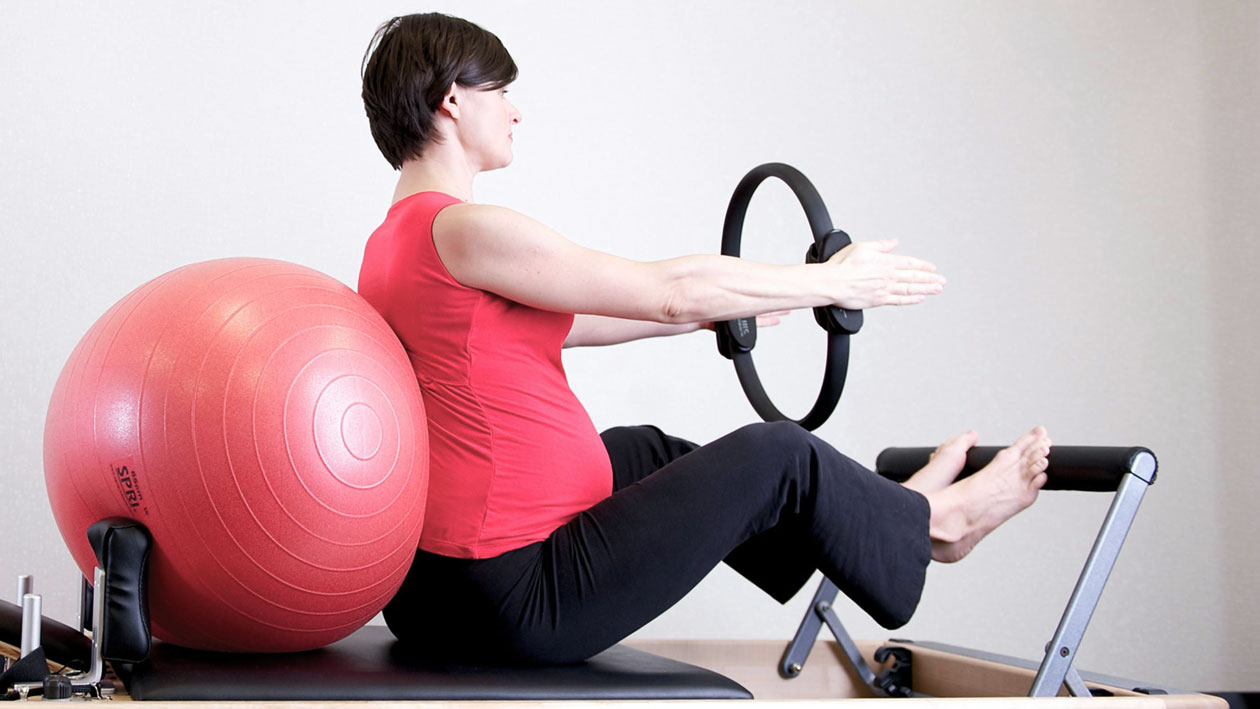
Yes, Pilates is one of the safest and most effective ways to exercise during pregnancy. With proper modifications, it strengthens the core and pelvic floor muscles crucial for labour and postpartum recovery. The key is to focus on stabilisation, avoid certain positions like lying on your back after around 16 to 20 weeks, and listen to your body.
Benefits of Pilates During Pregnancy
Pilates during pregnancy builds pelvic floor strength for labour and recovery, supports the deep core muscles carrying your growing bump, eases lower back and pelvic pain, helps you stay steady as your centre of gravity shifts, and teaches breathing control you can use during birth. It does all of this without impact on your joints.
Pelvic floor conditioning
Pregnancy places sustained load on the pelvic floor for nine months, and then a very sudden one at delivery. Pilates trains these muscles to both contract and release, which matters more than raw strength. A pelvic floor that can let go is as important during birth as one that can hold.
Deep core support
As your abdomen stretches, the transverse abdominis is the muscle doing the quiet work of supporting your spine and your bump. Pilates targets it directly, which is why it tends to be the recommendation when back pain sets in around the second trimester.
Back and pelvic pain relief
Lower back ache, rib flare and pelvic discomfort are the three complaints we hear most often. Strengthening the glutes, deep abdominals and upper back takes load off the structures that are struggling, and most people notice a difference within a few weeks of consistent practice.
Balance and posture
Your centre of gravity moves forward and upward through pregnancy. Pilates work on alignment and single-leg stability helps you adapt to that shift rather than compensating for it with a sway back. This is the same reason it supports your changing posture so well.
Breathing for labour
Lateral or diaphragmatic breathing is a core Pilates skill, and it is the same pattern used to stay calm and manage effort during contractions. Practising it weekly for months means it is automatic when you need it.
Is My Pilates Routine Pregnancy-Safe? A 2-Minute Self-Assessment
Before diving into specific exercises, let’s quickly assess whether your current routine needs adjusting. This simple checklist will help you identify any red flags in seconds.
Quick Safety Assessment
Take a moment to answer these questions honestly:
- Are you avoiding lying flat on your back (from around 16 to 20 weeks) or on your stomach?
- Are you avoiding deep twists and forward flexion (crunches)?
- Are you focusing on breathing into your diaphragm?
- Are you able to hold a conversation during exercise?
- Have you stopped any move that causes pain or “coning” of the abdomen?
What Your Answers Mean
If you answered “no” to any of these, your routine needs adjusting rather than abandoning. Here is the short version of how Pilates changes across the three stages of pregnancy:
- First trimester: continue largely as you are if you feel well, with medical clearance and your instructor informed.
- Second trimester: come off your back, drop deep abdominal flexion, and start using inclined and side-lying positions.
- Third trimester: work for comfort, balance and labour preparation rather than intensity.
The sections below cover each stage in detail, along with the exercises to stop entirely and what to replace them with.
Pregnancy-Safe Pilates Exercises: A Trimester-by-Trimester Guide
These exercises are specifically chosen to support your body through each stage of pregnancy. Focus on controlled movements and proper form rather than speed or repetitions. Remember: quality over quantity is your new mantra.
First Trimester: Building Your Foundation
During these crucial early weeks, you’re establishing movement patterns that will serve you throughout pregnancy. Even if you’re feeling nauseous or fatigued, these gentle exercises can actually help boost your energy.
Exercise 1: Pelvic Tilts
- Start position: Lie on your back with knees bent, feet flat on the floor hip-width apart
- Movement: Gently tilt your pelvis, drawing your navel towards your spine
- Breathe: Inhale to prepare, exhale as you tilt
- Repetitions: 10-15
- Self-Check: Feel your lower back gently press into the mat, there should be no gap
Exercise 2: Cat-Cow
- Start position: On all fours, wrists under shoulders, knees under hips
- Movement: Arch and round your spine slowly, moving between cat and cow positions
- Breathe: Inhale for cow (arch), exhale for cat (round)
- Repetitions: 8-10 cycles
- Common Mistake to Avoid: Moving too quickly, this should feel like a gentle massage for your spine
Exercise 3: Quadruped Leg Lifts
- Start position: All fours, maintaining neutral spine
- Movement: Extend one leg straight back, keeping hips square
- Hold: 3-5 seconds
- Repetitions: 8-10 per leg
- Form Tip: Imagine balancing a cup of tea on your lower back, it shouldn’t spill!
Second Trimester: Stability & Posture
Your centre of gravity is shifting now. These exercises help you maintain balance and support your changing posture.
Exercise 1: Side-Lying Leg Circles
- Start position: Lie on your left side, head supported, bottom leg slightly bent
- Movement: Small circles with the top leg, keeping hips stacked
- Repetitions: 10 circles each direction, then switch sides
- Common Mistake: Rocking the torso, keep your core engaged to stay still
Exercise 2: Modified Plank (on knees or incline)
- Start position: Knees on mat or hands on elevated surface (bench, wall)
- Hold: 15-30 seconds
- Repetitions: 3-5 holds
- Modification Tip: The higher the incline, the easier it becomes, start with a wall if needed
Exercise 3: Glute Bridges
- Start position: On your back (if still comfortable), knees bent
- Movement: Lift hips to create a straight line from knees to shoulders
- Hold: 3-5 seconds at the top
- Repetitions: 10-15
- Note: From around 16 to 20 weeks, perform this with shoulders elevated on a couch or bench
Third Trimester: Labour Prep & Comfort
These exercises prepare your body for birth whilst accommodating your beautiful bump.
Exercise 1: Wall Sits
- Start position: Back against wall, feet hip-width apart
- Movement: Slide down to a comfortable squat position
- Hold: 10-30 seconds
- Repetitions: 3-5
- Labour Benefit: Mimics positions that can help during delivery
Exercise 2: Clamshells
- Start position: Side-lying, knees bent at 90 degrees
- Movement: Keep feet together, open top knee like a clamshell
- Repetitions: 12-15 per side
- Focus Point: Feel this in your outer hip, crucial for pelvic stability [1]
Exercise 3: Wide Squats
- Start position: Feet wider than hip-width, toes turned out
- Movement: Lower into a squat, knees tracking over toes
- Repetitions: 10-15
- Breathing Tip: This is practice for labour, breathe deeply and steadily
The Official “Stop Doing” List: Pilates Moves to Avoid During Pregnancy
To protect your abdominal muscles and ensure proper blood flow to your baby, certain Pilates exercises must be completely avoided. This isn’t about being overly cautious. These restrictions are based on solid physiological reasons.
The Avoid & Replace Table
| Exercise to AVOID | Why You Must Avoid It | Safe Alternative to TRY INSTEAD |
|---|---|---|
| The Hundred, Crunches, Roll-Ups | Puts excessive pressure on the rectus abdominis, can worsen diastasis recti (abdominal separation) | Diaphragmatic Breathing exercises, Pelvic Tilts |
| Lying Flat on Your Back (from around 16 to 20 weeks) | Can compress the vena cava, reducing blood flow to you and baby, causing dizziness | Side-Lying Exercises, Incline Positions (45-degree angle) |
| Full Planks on Toes (later trimesters) | Can cause abdominal “coning” and dangerous strain on the linea alba | Modified Plank on Knees, Quadruped Holds, Wall Planks |
| Deep Twisting Movements | Puts unnecessary pressure on the uterus and already-stretched abdominal wall | Gentle Upper-Back Rotations while Seated |
| Any Position on Your Stomach | Puts direct pressure on the growing baby, obvious but worth stating | All-Fours Exercises (Cat-Cow, Bird Dog, Leg Lifts) |
| Jumping or Bouncing Movements | Can stress pelvic floor and cause discomfort or leaking | Controlled, Low-Impact Alternatives |
Troubleshooting Guide
If you see a “cone” or “dome” shape on your belly during any exercise:
Stop immediately. This indicates the exercise is too intense for your abdominal muscles. Choose an easier variation or skip it entirely.
If you feel dizzy, lightheaded, or nauseous:
You may be compressing your vena cava. Gently roll onto your left side and rest. Always exercise in positions that feel comfortable.
If you experience any spotting, cramping, or unusual discharge:
Stop exercising and contact your healthcare provider immediately.
Is Reformer Pilates Safe During Pregnancy?
Yes, reformer Pilates is safe through most uncomplicated pregnancies once your doctor or midwife has cleared you and your instructor is trained in prenatal work. The reformer is often easier to adapt than mat work, because spring tension can support a movement rather than only resist it.
That adaptability is the whole argument for the reformer during pregnancy. On a mat, the only variables are your body weight and gravity, and both of those are changing week to week. On a reformer, an instructor can lighten a spring to assist you out of a position you can no longer push out of, raise the foot bar to open up space for your bump, or add the box to give you an inclined surface so you keep working the same muscles without lying flat. The carriage also lets you offload the spine in ways that are difficult to replicate on the floor.
What it does not do is make an unmodified session safe. A standard group reformer class run at normal pace will still include supine abdominal work, prone work and deep flexion, none of which suit a pregnant body past the early weeks. The equipment is adaptable, the class is not, unless someone adapts it for you.
First trimester on the reformer
If you were already doing reformer Pilates before you conceived and you feel well, you can usually continue much as before. Tell your instructor straight away so they can watch your effort levels and keep you out of anything that involves holding your breath or straining. Nausea and fatigue are the more common limiters at this stage, not the exercises themselves. Ease the springs and shorten the session rather than skipping it entirely.
Second trimester: coming off the flat carriage
This is the stage where reformer work genuinely changes. From around 16 to 20 weeks, stop lying flat on the carriage. Most of that work can be rebuilt at an incline using the box or a wedge, which keeps you at roughly 45 degrees and avoids compressing the vena cava.
Footwork, leg circles in the straps, side-lying leg series and seated arm work in the straps all remain useful and comfortable. Long stretch, elephant and anything that loads the abdominal wall through flexion should come out. If you see coning along the midline at any point, the spring load or the position is wrong for you, and lightening the spring is usually the first thing to try.
Third trimester: box, incline and standing work
By the third trimester the reformer becomes mostly a stability, mobility and labour preparation tool. Seated work on the box, standing lunges with the carriage, kneeling arm series and supported squats against the foot bar are all comfortable and genuinely useful. Springs generally go lighter, ranges get smaller, and rest breaks get more frequent.
Balance is the thing to watch here. Getting on and off a moving carriage is harder than it was six months ago, so use the foot bar and have your instructor spot transitions.
Group class or one-to-one?
Group reformer sessions at our Bella Vista studio cap at six, which means our diploma-trained instructors can see every carriage. That works well through the first trimester. After that, we move clients across to semi-private clinical Pilates sessions, which cap at four and use the full equipment range including the Cadillac, Wunda Chair and barrels. Those pieces give far more scope for building a programme around a changing body than a reformer alone, and the smaller group means genuine hands-on correction on every exercise.
Pilates vs. Yoga vs. Barre: Which Is Best for Pregnancy?
Many expecting mums wonder which programme will serve them best. Here’s an honest comparison to help you decide.
Quick Answer: Pilates is unparalleled for targeted pelvic floor and deep core strengthening, exactly what you need for labour and recovery. Yoga excels at flexibility and mindfulness, whilst Barre is brilliant for muscular endurance. For labour preparation specifically, Pilates often has a slight edge due to its focus on the transverse abdominis and pelvic floor.
| Feature | Pilates | Yoga | Barre |
|---|---|---|---|
| Pelvic Floor Focus | Excellent | Good | Moderate |
| Core Stabilisation | Excellent | Good | Good |
| Flexibility | Good | Excellent | Good |
| Low-Impact | Yes | Yes | Yes |
| Labour Prep Benefit | High (Core/Breathing) | High (Mind/Body Connection) | Moderate (Endurance) |
| Equipment Needed | Minimal (mat) or reformer | Minimal (mat, blocks) | Some (barre or chair) |
Your Pregnancy Pilates FAQ
When is the best time to start Pilates during pregnancy?
You can start at any time, even as a complete beginner in your first trimester, as long as you have medical clearance from your healthcare provider. If you’re new to Pilates, begin with prenatal-specific sessions rather than modifying regular sessions on your own. The ideal scenario is starting before pregnancy to build a strong foundation, but it’s never too late to begin with appropriate modifications.
Is Pilates safe at 4 weeks pregnant?
Yes, for most people with an uncomplicated pregnancy. Very early pregnancy rarely requires exercise changes beyond avoiding overheating, breath-holding and heavy straining, because the physical changes that force modification have not happened yet. Speak to your doctor or midwife first, particularly if you have a history of miscarriage or any complications, and tell your instructor even though you are not showing.
How many weeks pregnant should I stop Pilates?
You can continue modified Pilates right up until delivery day, as long as you feel comfortable and have your doctor’s approval. Many women do gentle exercises even during early labour. The key is to continuously adapt your practice as your body changes. What feels good at 20 weeks might need modification at 30 weeks, and that’s perfectly normal.
What’s the difference between regular and Prenatal Pilates?
Prenatal Pilates proactively removes all potentially unsafe exercises and adds movements specifically designed to support pregnancy and prepare for childbirth.
Regular Pilates might include exercises on your stomach, deep twists, and intense core work, all unsuitable during pregnancy. Prenatal Pilates focuses on:
- Maintaining (not increasing) fitness
- Preparing the pelvic floor for delivery
- Addressing pregnancy-specific concerns like back pain
- Teaching breathing techniques useful during labour
Can I do Pilates with pelvic girdle pain?
Often yes, but the programme needs changing rather than simply softening. Pelvic girdle pain, sometimes called SPD, usually flares with movements that separate the legs or load one leg at a time, so wide squats, single-leg work and long strides are the first things to modify. Symmetrical, closed-chain work with the legs closer together tends to feel much better, and strengthening the glutes and deep abdominals generally helps over time. Tell your instructor exactly where the pain sits and what brings it on, and see a women’s health physiotherapist if it is limiting your walking.
Why do I feel less stable than I used to?
Relaxin and other pregnancy hormones increase the laxity of your ligaments to prepare the pelvis for birth, and that extra give affects every joint, not just the pelvis. Combined with a forward-shifting centre of gravity, it means your joints are relying more on muscular control and less on passive support. This is why Pilates suits pregnancy so well, and also why you should stay within a comfortable range rather than pushing into your new, deeper stretch. Flexibility that feels free right now is not necessarily flexibility you control.
Can I do hot Pilates while pregnant?
No, heated sessions are best avoided. Your core body temperature already runs higher during pregnancy and you dissipate heat less efficiently, so a heated room raises the risk of overheating and dehydration. This applies to hot mat Pilates, hot reformer and hot yoga alike. Take the same sessions in an unheated studio instead, keep water close by, and stop if you feel flushed, dizzy or unusually breathless.
Does Pilates really help with childbirth?
The evidence is encouraging, and there’s research to back this up. A strong, responsive pelvic floor and deep core can:
- Support a more efficient second stage of labour
- Speed up postpartum recovery
- Reduce the likelihood of stress incontinence after birth
- Help you manage effort and breathing through contractions
Studies have shown that women who exercise during pregnancy, particularly those who focus on core and pelvic floor strength, report feeling more in control during labour and have faster recovery times [2].
Why can’t I exercise on my back after 16 to 20 weeks?
Lying flat on your back can compress a major blood vessel called the inferior vena cava, which runs along the right side of your spine. This compression reduces blood flow back to your heart, which means less oxygen for you and your baby. This condition is called supine hypotensive syndrome and can cause:
- Dizziness or lightheadedness
- Nausea
- Shortness of breath
- A drop in blood pressure
The good news? Simply prop yourself up at a 45-degree angle or exercise on your side to avoid this entirely. Australia’s Pregnancy, Birth and Baby service sets out the same general guidance on exercising safely while pregnant.
Do I need to tell my Pilates instructor I’m pregnant?
Absolutely yes, and tell them immediately, even if you’re in your first trimester and not showing yet. A qualified instructor needs this information to:
- Suggest appropriate modifications from day one
- Monitor you for signs of overexertion
- Avoid putting you in unsafe positions
- Provide pregnancy-specific alternatives
Practise With Instructors Who Know Pregnancy
Soul Pilates & Movement is a boutique studio in Bella Vista serving The Hills District, with diploma-trained instructors, reformer sessions capped at six and semi-private sessions capped at four. That means someone is watching your form and adjusting your springs every single session, which matters more during pregnancy than at any other time.
Low impact, results driven, and built around where you are right now. Book a Class or call us on (02) 8416 8001 and we’ll talk through the right starting point for your stage.
Sources: